Thursday, July 29, 2010

July Aerial Survey

The NBEP crew had our third aerial survey Monday July 12th. As expected, many areas of the bay were cloudy with hypoxia and macroalgae was seen just about everywhere. When oxygen levels drop in marine waters sulfur precipitates out, causing the water to become cloudy. The Seekonk River was streaked red with phytoplankton which may be a dinoflagellate or diatom (like the dinoflagellate Gynodinium we found in May), however we were not able to obtain a sample to identify it.
The wrack line at Conimicut was loaded with a filamentous Ulva.
Ground truthing showed expected results: Ulva is heavily coating the northern parts of the Bay, however, the species are changing. While in the past we have seen the big sheets of Ulva (commonly known as sea lettuce) covering beaches, the filamentous Ulva was found in big mats along the shores of Conimicut.

Also, this time last year we were seeing the brown seaweed Punctaria mixed into the Ulva, but this year the red seaweed Grinnellia has taken its place.

Punctaria latifolia. Image: Carol Thornber, URI


Grinnellia americana. Image: algaebase.org

Sunday, July 11, 2010

Seafloor (Benthos) Survey

On June 21, in collaboration with the University of Rhode Island’s Cell & Molecular Biology department, we completed a videotaping survey throughout six different locations in Narragansett Bay.  We will be surveying six locations throughout Greenwich Bay. Click on the map below to see our locations marked in yellow.[googlemaps http://maps.google.com/maps/ms?ie=UTF8&hl=en&msa=0&msid=103382247568443412834.00048af7f4a77de62dac3&t=h&ll=41.671466,-71.435667&spn=0.02943,0.021252&output=embed&w=425&h=350]

Liquid Nitrogen Storage Tank.
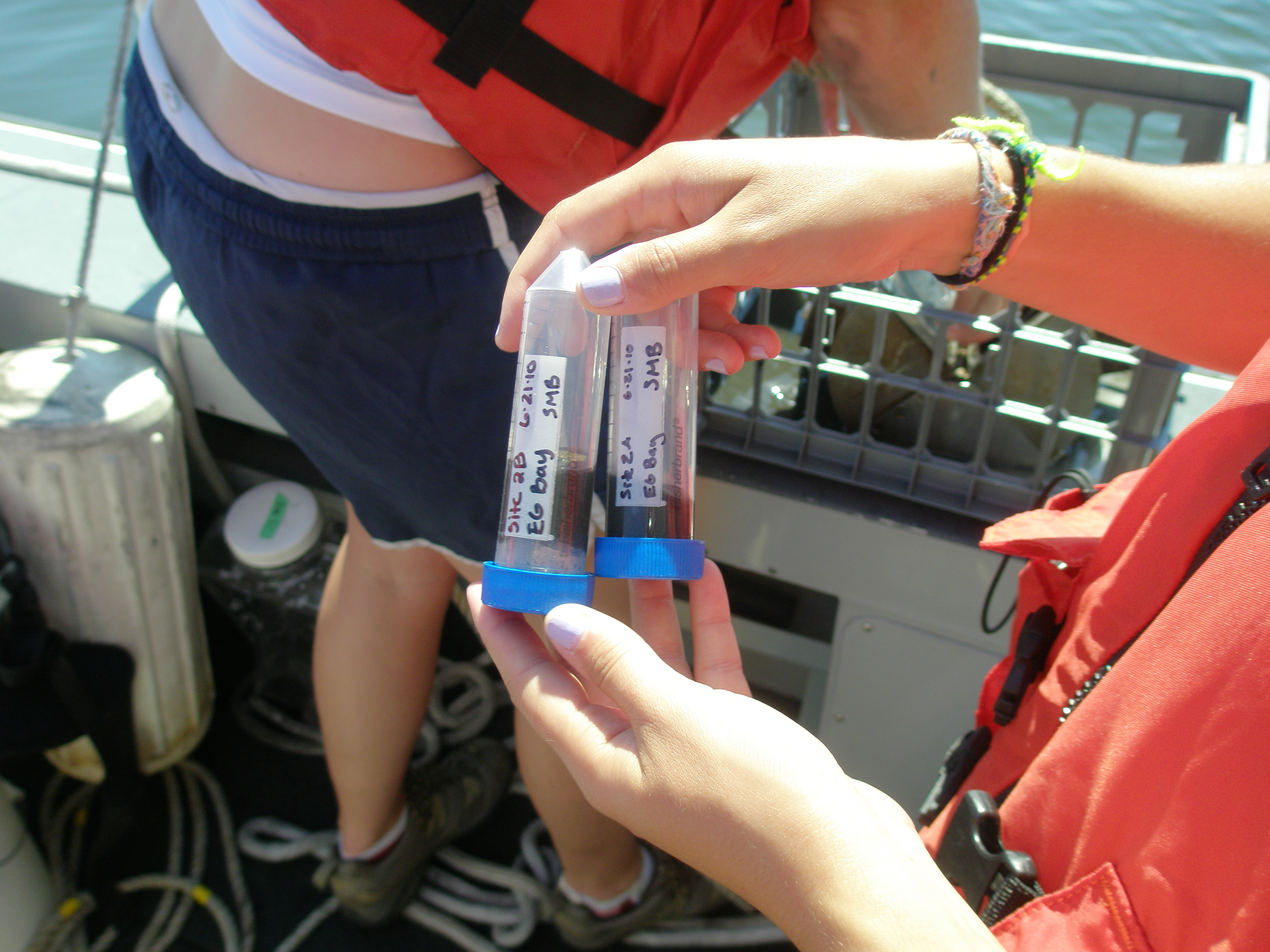
Sediment samples
A GPS, in correlation with the program Chartview Pro, was used to track the exact locations that we surveyed so we can return to them each time. At each of the six locations, we used the SeaViewer Underwater camera to capture video clips of the benthic regions in the Bay. We used a YSI to measure temperature, salinity, dissolved oxygen (DO), and chlorophyll at surface and bottom depths (click on yellow icons above to see our readings).  A Niskin water sampler was used to take water samples at the bottom, as well as a sediment grab which plunges into the ground to collect sediment samples. The sediment samples were preserved in a liquid nitrogen storage tank. Both sediment and water samples will be tested by the molecular biology students.

Aghardiella (a red branching seaweed) with
Ulva (green "sea lettuce) underneath.
After viewing the video footage, we found a plethora of interesting marine life living in the sediment in the Bay.  For instance, single-celled algae was found, as well as the red algae Aghardiella species and Gracilaria species. Ctenophores, commonly referred to as “comb jellies” were also abundant at the surface and benthic regions in the Bay.  Amphipods, tunicates, and crabs were among the other species found within the sediment.
Aghardiella (a red branching seaweed)

Wednesday, June 30, 2010

June Aerial Survey

On June 22nd the crew took a helicopter survey and found many areas of Narragansett Bay to be heavily loaded with algae. Some areas, particularly the coves in Greenwich Bay, had a milky hue to them which is indicative of low dissolved oxygen. Much of Greenwich Bay and Allen Harbor had bright red streaks in the water.

The red streaks in the water are patches of the dinoflagellate Gynodinium.
Certain types of phytoplankton (microscopic algae) grow very quickly and form thick, visible patches. Some of these phytoplankton blooms are harmful to plants, animals and humans, and are known as harmful algal blooms (HAB). After we landed we traveled down to Allen Harbor to collect a water sample to take back to the lab and look at under the microscope. Fortunately, the red phytoplankton we saw was not a HAB. A fellow professor here at the URI Bay campus identified it to be a harmless species of Gymnodinium, a dinoflagellate. There are however, several species of Gymnodinuim that produce toxins that cause shellfish poisoning. These red-tide events often coincide with high concentrations of nutrients, especially iron and high temperatures.

For more information on dinoflagellates
go to www.keweenawalgae.mtu.edu/

After our aerial flights we go out to the beaches to identify the algae species seen from the air. As expected, we found the northern part of the Bay (north of Conimicut) loaded with the green algae Ulva species (sea lettuce). Conimicut and many areas south to Narragansett beach have a wide variety of red, green and brown algae.


The green seaweed Ulva and brown seaweed Fucus cover Bold Point.


A mix of reds, greens and browns were found at Sabin point.

Friday, June 11, 2010

Meet the Science Research Team of 2010

Every year NBEP hires at least one intern to help us out with our summer research. Whether we hire through the RI Department of Environmental Management or the University of Rhode Island, our interns must have a strong interest in the environment and have at least two years of higher education schooling in marine or environmental sciences.

The Veterans

Dr. Chris Deacutis

Dr. Chris Deacutis — Has been the Chief Scientist for NBEP since 1993.  Prior to joining the NBEP team, Chris worked with RI Department of Environmental Management in the Division of Water Resources. It was his research and suggestion of hypoxic problems in Narragansett Bay that sparked the efforts of the Insomniacs in 1999. From the summer of 1999 to 2003 Chris organized and coordinated nighttime dissolved oxygen surveys. Since 2004 Chris has been collaborating with Brown University and the University of Rhode Island to conduct daytime dissolved oxygen surveys throughout the summer.


Lesley Lambert
Lesley LambertAfter graduating from Roger Williams University in 2005 with a major in Marine Biology and a minor in Economics, I began working with NBEP in 2006 as an RIDEM intern and had the great fortune to continue with the program, becoming Project Coordinator. I have recently become the Digital Communication Manager, so in addition to conducting the summer research and mentoring our interns, I am now in charge of maintaining our website, designing the Narragansett Bay Journal, and other outreach materials and events.


2010 Interns:

Rebecca Sacks
Rebecca Sacks Becca is a senior at the University of Rhode Island, majoring in Marine Biology. She began working with us during the spring semester while maintaining a full course schedule. In the past four months she has received experience in analyzing aerial photographs as well as algae identification and biomass estimates through ground truthing. We look forward to having Becca on our team and showing her the ropes of working in the local environmental field.


Bart Johnsen-Harris

Bart Johnsen-Harris Bart is a Junior at Brown University majoring in Environmental Studies. Aside from his strong interests in environmental policy, he is also an outstanding piccolo player and bass singer for Brown's Wind Symphony and "Bear Necessities" a cappella group. Bart will be assisting us on our boat surveys this summer.


We will post our 2011 interns when they come on board next week!

Thursday, June 10, 2010

First Water Quality Survey of the Summer

The NBEP science team embarked on our first water quality survey of the season on June 8th. We used the R.I. Department of Environmental Management (RIDEM) boat and left from the East Greenwich Bay Marina. We were able to take measurements at 28 of our 30 fixed sites throughout Greenwich Bay and the west passage of Narragansett Bay before a squall came about and forced us to go in and get out of the inclement weather.
Sudden Bad weather
Sudden Squall

The north western part of Greenwich Bay was found to be just at the hypoxic level at 2.9mg/L of dissolved oxygen. However, the southern parts of Greenwich Bay and much of the rest of the Bay was well mixed and oxygen levels were sufficiently high. The squall likely mixed the water  and oxygenated it further.

Marine animals breath oxygen too and when oxygen levels drop below 3mg/L there is not enough oxygen to go around. Creatures that live on the bottom of the bay such as oysters, littlenecks, and marine worms are at a greater risk during hypoxic events because they cannot move to a different area. Schooling fish such as menhaden are also affected by hypoxia because they are often chased into coves by predators such as striped bass and the school will use up the oxygen faster than it can be produced by photosynthesis or mixed into the water at the surface from the air.

Our next water quality survey will occur in the second week of July, however we hope to do a video survey next week to look at the sediments throughout Greenwich Bay.
Our captain Heather and intern Bart.
Lesley and Becca work on gathering the data.